


A. Introduction — Break the Myth: “You’re Not Lazy”
Every year, I hear the same thing from my students over and over again—
“Sir, I lack motivation.”
“I study, but I can’t focus.”
“I want to do something, but I don’t feel like it…”
And when I hear these lines, I think—these students aren’t lazy; they’re confused and scared.
They have the desire to work, but fear stops them.
Fear of what?
• Fear that I might fail.
• Fear that people will say if I don’t perform well.
• Fear that I won’t be able to live up to my parents’ expectations.
• And sometimes… just a strange fear that “I might not be capable enough.”
It is this fear that blocks our actions.
We want to do something, but there is an invisible wall—and that wall’s name is fear.
Have you ever noticed? When we are genuinely not afraid of something, we do it immediately.
But when the result or judgment comes to mind—we delay, overthink, and then call ourselves “lazy.”
Truth: You’re not lazy—you’re just scared of failing before even trying.
“Fear wears the mask of laziness.”

And when we call ourselves “lazy,” we underestimate our potential.
Then we start thinking, “I’m just like that,” when in reality, our brain is simply protecting us from failure, rejection, and the pain of effort.
Remember this:
✨ “Procrastination is not a time problem. It’s an emotion problem.”
Until you face your fears, motivation is never enough. Motivation comes after action, not before.
So the next time you feel lazy—stop and think.
You’re not lazy, you’re just a little brave.
If someone tells you that I was never afraid, I never doubted myself, then understand that he is lying, the only difference is that some people stop with fear, and some start even with fear.
B. Story 1 — The Scared Topper
Rohan was an average student—at least that’s what everyone thought.
His attendance was perfect, he submitted assignments on time, but he always panicked during exams. His friends jokingly said, “You’re so lazy.” And gradually, Rohan believed it too.
But one day, his professor called him to meet after class.
Rohan was a little hesitant, but he went. The professor asked, “Rohan, do you think you’re lazy?”
Rohan bowed his head and said, “Yes, sir… I try, but I can’t focus on my studies. Maybe I’m just like that.”
The professor smiled.

He picked up a piece of paper and pen and wrote:
“You’re not lazy. You’re scared.”
Rohan looked at him—confused.
The professor said,
“You’re not lazy, son. You’re scared. You’re afraid that if you give your full effort and don’t get results, what will people say? You’ll exhaust your excuses. Then there’ll be nothing left to blame.”
That line struck deep into Rohan’s heart.
That night, he thought—“Am I really afraid of my potential?”
And for the first time, he decided, “I’m not perfect, I’ll just be consistent.”
The next morning, he started a small habit—
He told himself he would target small goals and try to be consistent. These steps helped him overcome his dark self-doubt, increase his self-confidence, and most importantly, he began to love himself, and this process positively affected his results.
People were surprised,
“Rohan? This was never serious!”
But only Rohan knew—
the day he acknowledged his fear, accepted himself, was the day his real growth began.
Never mistake your delays, distractions, or demotivation for laziness.
Take a look inside yourself—there may be a fear lurking behind your “laziness.”
Fear of failure, fear of expectations, fear of disappointment.
And when you identify and accept that fear—half its power is lost.
You’re not avoiding work. You’re just avoiding the pain of trying and failing. But remember—failure hurts less than regret.
C. The Psychology Behind It — Why Fear Feels Like Laziness
If you look inside your mind, you’ll find—the problem isn’t with your willpower, it’s with your emotions.
What is the main function of the human brain?
👉To keep you safe.
Whenever you start something new, challenging, or uncertain—like preparing for a competitive exam, or a research project— a part of your brain called the amygdala, the fear center, is activated.
It signals to the brain—”This is risky. What if you fail? What if others do better? What if you look foolish?”
And just like that… from that moment, your body goes into ‘danger mode.’
Result?
You either postpone or avoid—and it appears that you’re “lazy.”

But in reality, it’s not laziness—it’s a protective mechanism.
Your brain is trying to protect you from the pain that failure can bring.
“Procrastination is not a time problem. It’s an emotion problem.”
4 Types of Fear That Disguise Themselves as Laziness
1. Fear of Failure
Most common. You don’t even start because you’re afraid—”What if I fail?”
Result: You seem safe, but progress is zero.

2. Fear of Judgment
“What will people think if I say the wrong thing?” The very thought crushes confidence.
3. Fear of Imperfection
“I’ll only start when everything is perfect.” But perfection never comes—and you never get started.
4. Fear of Success
It sounds strange, but it’s true.
Many students subconsciously fear that if they succeed, expectations will rise. And that pressure already makes them uncomfortable.
Fear doesn’t stop you from doing things; it just convinces you that you can’t.
Break that illusion—start anyway.
D. Story 2 — Edison’s Fear of Failure
Thomas Alva Edison—a name we’ve all known since childhood.
The scientist who invented the electric bulb.
But do you know the real story behind it?
Edison failed 10,000 times before creating the light bulb. When a journalist asked him,
“Mr. Edison, how does it feel to have failed 10,000 times?”
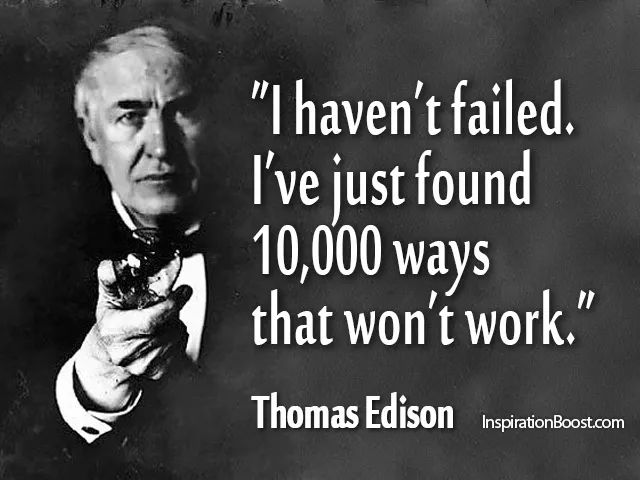
Edison smiled and replied, “I didn’t fail 10,000 times. The light bulb was an invention with 10,000 steps.”
What an answer!
This line changes a mindset.
🌱 The Lesson Hidden Behind Edison’s Smile
Edison was also human. He too had fear—fear of rejection, fear of wasting years, fear of people’s judgment.
But he understood one thing:
“Failure doesn’t define me—my effort does.”
Your fight isn’t with any outsider, your fight is with yourself—the one who keeps talking…all the time, asking what will you do if you don’t succeed, asking you if you’re on the wrong path.
Practical solution: Let’s imagine you went to live in a colony for the first time and there you met someone who, upon seeing you, started abusing you and speaking negatively. You started getting angry at him and started asking yourself what mistake did I commit but as soon as you came to know that the person is crazy and keeps roaming here and there like this, you stopped reacting because now you know him. Now you have to apply this same formula to yourself. Your mind is like that crazy person and whenever you are in the process of doing something big, it scares you by creating images of negative fears. Now what you have to do is just watch it doing it, without being judgmental, without reacting, because you know it. This way you can reduce the power of negativity and focus more on your work.
Don’t let the fear of failure stop you from trying.
Because freedom comes only after fear—
and excellence only after effort.
E. Story 3 — A Dreamer Who Delayed
Neha was a third-year graduate student. She was intelligent and sincere, but she always had one line:
“Sir, I want to take a competitive exam… but I’m not in the mood right now.”
She had everything—books, notes, online lectures, even a brand-new planner.
But every day the same pattern repeated— She would sit down to study, and after five minutes, she would pick up her phone. The day would end while scrolling through Instagram. And at night, guilt would overtake her—”I’ll start seriously tomorrow.”
This “tomorrow” didn’t just last a day, it lasted for six months.
🌱 The Hidden Truth
Neha thought she was lazy. But the real problem wasn’t laziness—it was fear.
She feared that if she tried her best and didn’t clear the exam, people would say, “You didn’t even study so hard?” She feared her parents’ disappointment, and most of all—she feared her own failure.
She thought, “If I don’t try, I won’t fail.”
But this thought was keeping her locked in an invisible cage.
She was afraid of her own potential.
💡 The Moral for Every Student
Your “I’ll start studying tomorrow” is a symptom of fear. Every time you delay, it’s a signal of your inner fear. And until you accept that fear, you’ll never overcome it.
“The best way to overcome fear is through action.” Tell yourself, “I’ll start right now, even for 15 minutes. In the next 15 minutes, tell yourself how I can make this process the best, most interesting, and entertaining. The action may be small—but that one step takes you out of that emotional blockage. Remember, the most important thing is to start.
Remember: “When you stop fighting your fear and start walking with it, success becomes your companion.”
⚙️ F. Practical Steps — How to Beat This Fear
By now you should have figured out—laziness is just a mask,
and behind it hides fear—of failure, judgment, or perfection.

But now the question is—
“Sir, if I’ve realized I’m afraid, then how do I get over this fear?”
This is the most important part—how to break the fear cycle and take consistent action. So let’s take a step-by-step look 👇
🪜 Step 1: Start Small—Because Big Goals Scare the Brain
When we set a big goal—”It’s too hard. What if you can’t do it?”
And then we delay.
🧠 Psychology says – your brain doesn’t fear work, it fears discomfort.
So the trick is to make the goal so small that it doesn’t seem “threatening”.
👉 Example:
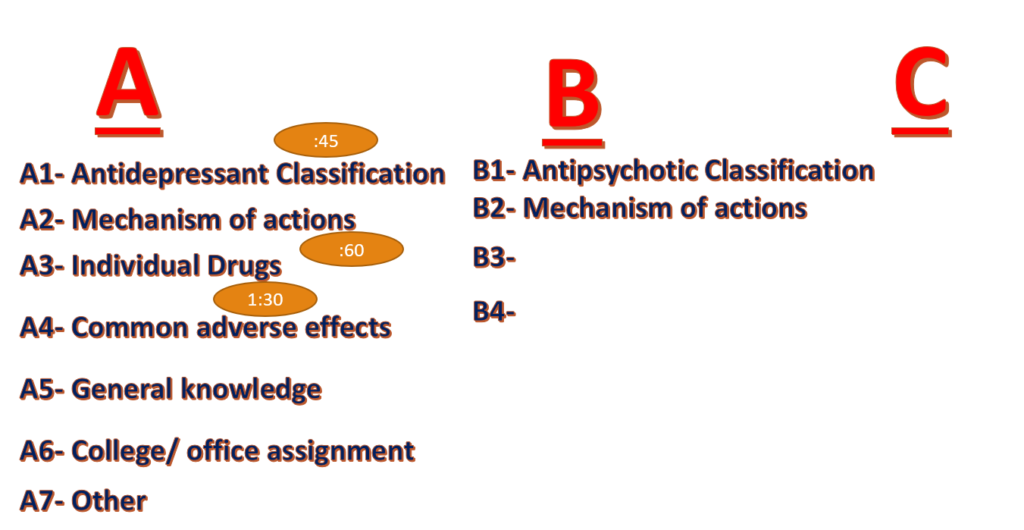
Like I follow the Eisenhower Matrix. In that too, I write the goals by dividing them into small parts (like A1, A2, A3). I give them a hypothetical time as per my calculation and then try to complete it quickly, this makes the whole process gamified and interesting.
🪶 Step 2: Write Down Your Fear —
Take It Out of Your Head. As long as your mind keeps fear inside, it makes it 10 times bigger.
But as soon as you write — “What am I afraid of?” — that fear loses its power.
📝 Try this exercise:
Write down your fear in one line, e.g.,
• “I am afraid of failing the exam.”
• “I am afraid of speaking in front of people.”
Then ask yourself:
“Even if this happens, will my life end?”
You’ll realize — No.
You’ll simply try again, learn better, and improve. And this realization gives you freedom from fear.
🧩 Step 3: Focus on Progress, Not Perfection
Perfection is an illusion. You will never feel ready—not for exams, not for life. But progress is always possible. Measure your effort, not the result.
“Perfection paralyzes, but progress empowers.”
🎯 Step 4: Reward Effort, Not Just Results
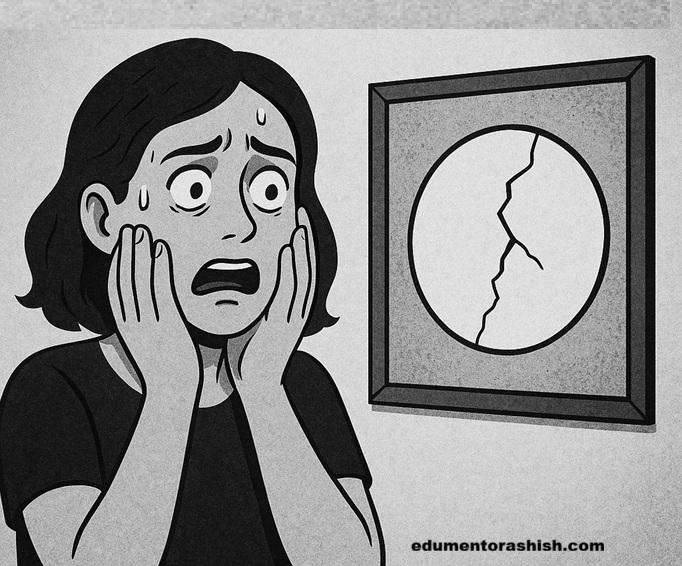
When you work only for results, and don’t get results, your brain feels punished.
Then the next time, it starts avoiding the same effort. But if you reward your effort—
“I did my work sincerely today,”
“I controlled my distractions today,”
then your brain releases dopamine—
which doubles your motivation the next time.
👉 Simple habit:
After every small success of a day (even if you completed 60-70% of your daily target), reward yourself—a walk, a song, or a small treat.

🧭 Step 5: Compete Only with Your Past Self
Comparison is the most dangerous fear. Thoughts of comparison only increase pressure, not performance. Your competition is not with anyone else, but with yourself.
Keep your focus on your improvement:
• Were you better today than yesterday? ✅
• Am I learning? ✅
• Am I consistent? ✅
“Don’t compare your chapter 2 with someone else’s chapter 10.”
🧘 Step 6: Reprogram Your Mind with Affirmations
Tell yourself as soon as you wake up in the morning and before bed—
“I am not lazy, I am learning to act even when I’m scared.”
“I am improving every day.”
“I don’t need to be perfect, I just need to start.”
“I am not a loser.”
These lines seem simple, but they rewire the brain—replacing fear with confidence.
🔬 Step 7: Stay in Action Mode — No Matter What
It’s better to do a little bit every day than to do nothing at all while waiting for something to be perfect one day. Your goal shouldn’t be “I never fear,”
but rather, “I will take action even with fear.”
“Courage is not the absence of fear — it’s moving forward despite it. And you don’t need to be fearless to act. You just need to act — and fear will disappear.”
G. Story 4 — The Bamboo Tree: A Lesson in Patience and Inner Growth
Once, a farmer planted bamboo seeds in his field. He watered them daily, dug the soil, and provided sunlight— with complete hard work and dedication. The first year passed—nothing happened.
The second year passed—not a single leaf emerged from the ground. The third year, the fourth year… still no growth. People started making fun of him—
“You’re wasting so much time.
This bamboo is never going to grow.”
But the farmer didn’t stop.
He kept watering the bamboo every day—without seeing results, without complaining.

And then one day—at the beginning of the fifth year—
a small green shoot emerged from the ground.
In just a few months, that shoot grew to 90 feet!
Everyone was astonished.
“How is that possible?”
The farmer smiled and said, “This bamboo didn’t grow in 6 weeks, it took 5 years.
It was forming its roots underground for years.” Don’t expect immediate improvement or positive results, because while you may be feeling your efforts were wasted, the roots will be developing patience, consistency, and mental strength within you.
And when those roots become strong — then your growth is explosive.
“Every silent effort you make today is building the roots of tomorrow’s achievement and Patience is not waiting — it’s trusting that your hard work will bear fruit. So Be patient with yourself.
Even silence and struggle are signs of growth.”
🔥 H. Conclusion — From Fear to Fire
Have you ever thought how many brilliant minds are held back by just one feeling—fear—?
How many students’ dreams remain pending simply because they admit defeat before even trying. And when they can’t understand their fear,
they label themselves incorrectly—”I’m lazy.”
Step 1 — Accept the Truth
“Awareness is the first step to transformation.”
Step 2 — Shift from “What If I Fail?” to “What If I Learn?”
This very line turns on your energy switch.
Step 3 — Replace Fear with Action
“Confidence is built by doing the things you are afraid of—not by avoiding them.”

Step 4 — Redefine Failure
Failures are not full stops; they are commas in your success story.
Step 5 — Turn Fear Into Fire
That fear is proof that your dream is valuable.
And when a dream is valuable, the struggle for it is also worthwhile.
Step 6 — Your New Identity
From today onward, don’t call yourself “lazy.” Replace that line with:
❌ “I’m lazy.”
✅ “I’m learning to act, even when I’m scared.”
Final Message
Dear student,
Life doesn’t demand perfect from you, it demands honest effort. Success comes to those who start—even when scared. So if your heart is saying today, “I can’t find motivation,” then say this to yourself: “I don’t need motivation, I just need a start.”
That small start, that 15-minute action, that step taken after a dare—that’s what will change your life.
“Fear ends where action begins.”
🚀 Call to Action
If you too want to overcome your fear, and want to make your journey a growth story—
then start today.
There will be no perfect moment— the perfect moment is when you start.
For more motivational stories, pharmacy career guidance, and study inspiration, visit 👇
🌐 EdumentorAshish.com
📺 YouTube Channel : Edumentor Ashish
📩 Mail: edumentorashish@gmail.com
“You are not lazy, you are just scared. But once you act, even your fear will start respecting you.”