

A. The Illusion of Knowledge: When Confidence Outpaces Reality
Have you ever noticed that the most confident people in life are often those who are actually still in the initial stages of learning?
After spending just, a short time in a field, a professional starts to think,
“I know everything, I’ve learned quite a lot in this field.”
But when a decision goes wrong, the blame is placed on the market, the system, or the team — there’s no self-reflection.
A student reads 2-3 lectures or short notes and says,
“Sir, this topic is very easy.”
But when conceptual questions appear in the exam, that confidence turns into silence.
A teacher, after a few years of experience, thinks,
“I don’t need to learn anything new, I know everything now.”

Teaching becomes routine, curiosity gradually diminishes, and improvement comes to a standstill — without us even realizing it.
The problem here isn’t intelligence, degree, or experience.
The problem here is a psychological trap —
👉 “We think we know, so we stop learning.”
This state is called the Illusion of Knowledge in psychology. And when this illusion becomes strong:
• We stop taking feedback
• We start justifying our mistakes
• And the doors to growth slowly close
This illusion has a scientific name —
This effect works quietly. It doesn’t make us fail, it makes us believe that we don’t need to improve. And this is why:
• Some students keep studying but fail to grow.
• Some teachers don’t keep up with the times despite their experience.
• Some professionals don’t become better despite many years of experience.
In this blog, we will understand:
• What the Dunning-Kruger effect is.
• How it affects students, teachers, and professionals.
• And most importantly — how to overcome it.
👉 Because real growth begins where confidence is combined with humility.
B. What Is the Dunning–Kruger Effect?
The Dunning-Kruger effect is a psychological phenomenon or cognitive bias in which people overestimate their knowledge and skills. According to this effect, people who know less about a topic often overestimate their abilities because they lack the understanding to recognize their own mistakes.
On the other hand, those who know more clearly understand their limitations. This is why they question themselves more and constantly strive to improve.
This concept was explained in 1999 by psychologists David Dunning and Justin Kruger. Their simple conclusion was:
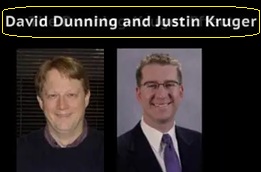
“Incompetence itself cannot recognize its own incompetence.”
Initially, after gaining even a little knowledge in their field, a person starts to feel like they know everything. This is why beginners often appear more confident and experts more humble—and this is where the real impact of the Dunning-Kruger effect begins.
C. The Dunning-Kruger Curve: From Overconfidence to True Expertise
The easiest way to understand the Dunning-Kruger Effect is through the Dunning-Kruger Curve.
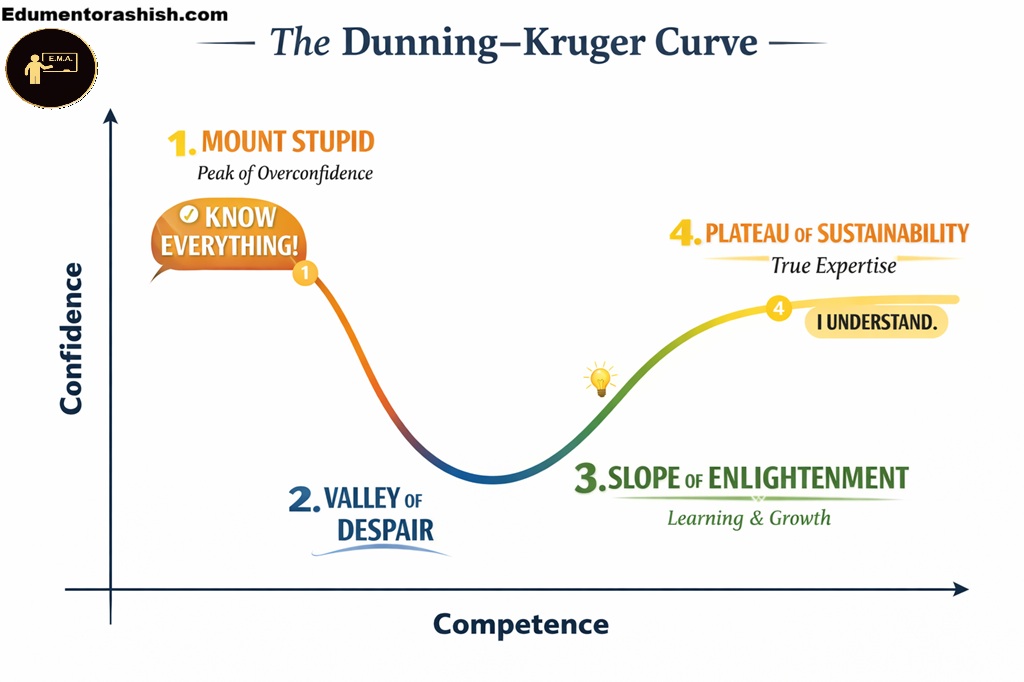
This curve shows how our confidence fluctuates as we learn.
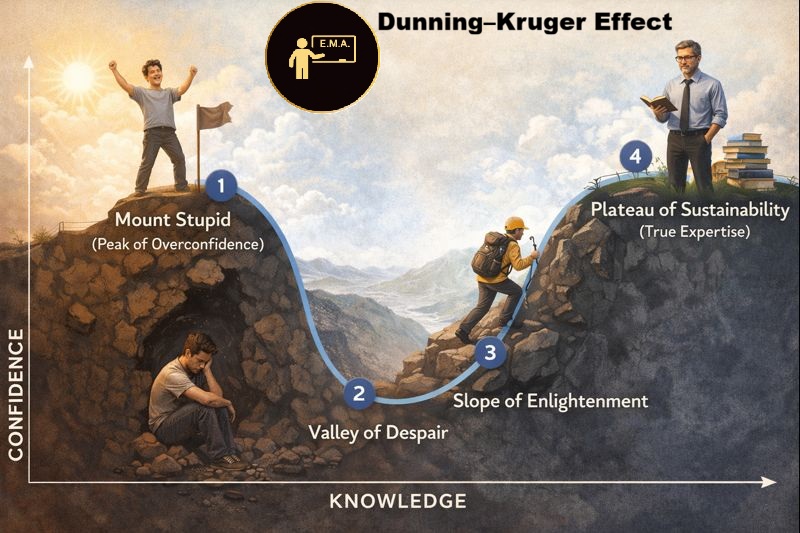
1️⃣ Mount Stupid (Peak of Overconfidence)
In the initial stages of learning, a little knowledge leads to a sudden surge in confidence. At this stage, one feels, “I know everything.” But in reality, the understanding is still shallow.
2️⃣ Valley of Despair
When reality hits, mistakes are realized, and confidence plummets. This is the most painful stage; people feel they know nothing, that they are not cut out for this field, and many give up here.
3️⃣ Slope of Enlightenment
If someone crosses this phase, learning becomes systematic. Patience develops, and confidence gradually becomes more realistic.
4️⃣ Plateau of Sustainability (True Expertise)
This stage belongs to true experts — where there is deep understanding, humility, and a continuous learning mindset.
👉 Real expertise is not loud; it is disciplined and humble.
D. Dunning–Kruger Effect in Students
The Dunning-Kruger effect is very common among students, especially in competitive exams and professional courses. After attending a few lectures, reading short notes, or watching YouTube videos, they often start thinking, “I’ve mastered this chapter.” They gain confidence, and sometimes even feel they can explain the chapter better than the teacher, but this is just the very early stage.

At this stage, the student:
• Postpones revision
• Avoids practice questions
• Overestimates their preparation
When the exam or test arrives, reality hits. The questions seem unfamiliar, confidence collapses, and then the blame shifts to the system, the paper, or luck.
The problem isn’t a lack of intelligence; the problem is false confidence.
Smart students are those who understand that:
“What I don’t know yet is more important than what I already know.”
The best way to avoid the Dunning-Kruger effect is through honest self-assessment, regular testing, and seeking proper guidance from seniors or teachers. Only when confidence grows alongside preparation does performance truly improve.
E. Dunning–Kruger Effect in Teachers and Educators
For teachers, the Dunning-Kruger Effect is a bit subtle, but the impact is profound. After years of experience, they often start thinking, “I’ve seen it all, what more is there for me to learn?” This is where growth quietly slows down.
Teaching is a dynamic skill. Students change, learning styles change, technology changes — but if a teacher doesn’t update their methods, a gap is created. Experience is valuable, but experience without reflection becomes mere repetition.
Because of this effect:
• Feedback is ignored
• New tools and pedagogy are rejected
• Teaching becomes a mechanical routine
Great teachers are those who see their experience not as something to be proud of, but as a responsibility.
“I’m still learning” — this line makes a teacher powerful, not weak.
Only when an educator remains a learner can they become a true role model for their students.
F. Dunning–Kruger Effect in Professionals and Leaders
In the case of professionals, the Dunning-Kruger effect often develops subtly with experience. After working in the industry for a few years, one starts to think, “I know everything, I don’t need any guidance.” This is where learning slows down and growth plateaus.
The biggest drawback of this effect is its impact on decision-making. Due to overconfidence:
• Risk assessment becomes flawed
• Feedback is taken personally
• Listening to the team decreases
This effect becomes even more dangerous in leadership, as a wrong decision impacts not only the individual but the entire team or organization. True professionals don’t consider their experience as the final authority, but rather as a foundation for further learning.

The “I know everything” mindset hinders growth, while the “I need to learn more” mindset propels one’s career forward.
Those who are successful in the long term carry both competence and humility.
G. How to Overcome the Dunning–Kruger Effect and Keep Growing
Understanding the Dunning-Kruger Effect is important, but overcoming it is even more crucial. The good news is that it’s not a permanent problem — awareness is the first step towards a solution.
1️⃣ Develop Self-Awareness
Regularly ask yourself:
“What are my weaknesses, and how can I improve them?” Honest self-assessment is the first step towards growth.
2️⃣ Treat Feedback as a Tool, Not a Threat
Instead of avoiding criticism, use it as a source of learning. Those who can listen to feedback are the ones who can improve. It’s a tool that continuously makes you and your organization better and stronger.

3️⃣ Make Learning Systematic
Structured learning is more effective than random motivation or scattered information. See who has done well in your field, and who is currently doing well. How and in what ways can you learn from them?
4️⃣ Teaching and Application
Apply what you learn or teach it to someone else. Gaps will automatically become apparent. While teaching, you’ll discover many things about where you need to improve.
5️⃣ Replace Ego with Curiosity
Curiosity makes you better, ego keeps you stuck. Real growth begins where confidence is combined with humility — and this is the real way to overcome the Dunning-Kruger Effect.
8. Conclusion: Real Intelligence Begins Where Ego Ends
The Dunning-Kruger Effect doesn’t tell us that we are weak, but rather shows that the biggest obstacle on the path to growth can be ourselves. Whether you are a student, a teacher, or a professional — as long as we believe that “I know everything,” learning automatically stops.
Real intelligence doesn’t come from degrees, designations, or experience. Real intelligence comes from the acceptance that:
👉 “I still have more to learn.”
Those who understand this:
• They are not afraid of feedback
• They turn mistakes into learning opportunities
• And achieve sustainable success in the long term
Confidence is necessary, but when confidence is combined with humility — that is true wisdom.
A Small Reflection for You
Ask yourself a question:
At which stage of the Dunning-Kruger Curve am I today?
If this blog makes you reflect on yourself even a little, then its purpose has been fulfilled.
📌 For more articles related to learning psychology, self-growth, and career clarity,
👉 stay tuned to edumentorashish.com.
👉 You may also contact me via email at edumentorashish@gmail.com
👉 You can explore our official YouTube channels:
• Dr. Ashish Pathak Online (for pharmacy-related content)




wow your article is simply a masterpiece, i like that, keep it up and will be checking for new update. do you post often? you can check the biggest webdesign freelancer in platform in germany called https://webdesignfreelancerfrankfurt.de/ Thank you for your wonderful post
wow your article is simply a masterpiece, i like that, keep it up and will be checking for new update. do you post often? you can check the biggest webdesign freelancer in platform in germany called https://webdesignfreelancerfrankfurt.de/ Thank you for your wonderful post