

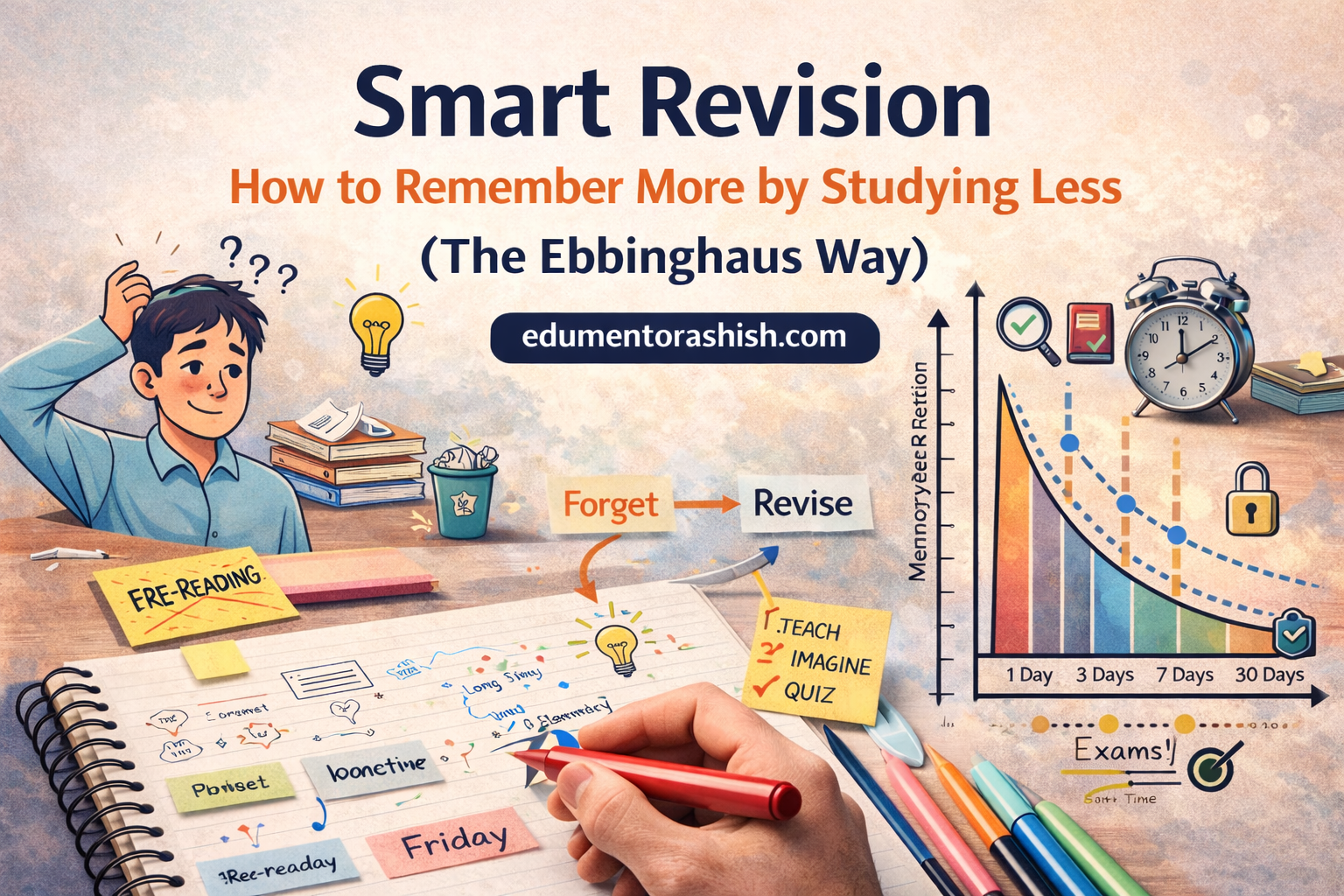
A. Introduction
Has it ever happened that you studied with complete sincerity, and before going to sleep at night you felt, “Yes, everything is clear”…
but just before the exam, or as soon as you saw the paper in the exam hall, your mind went blank? It felt like you couldn’t remember anything.
You studied properly, attended lectures, and worked hard—then why couldn’t you remember? 🤔
Often students think,
“Maybe my memory is weak”
“I’m not intelligent”

But the truth is, the problem isn’t intelligence; the problem is the revision strategy.
You don’t forget because you’re not smart; you forget because you don’t revise scientifically. If you don’t know about a scientific revision plan, believe me, you are wasting most of your time studying.
👉 By the end of this blog, you will understand:
• how to remember more by studying less,
• how smart revision strengthens memory,
• and how to eliminate the “I’ve forgotten everything” feeling before exams forever.
Let’s begin—by understanding the science of forgetting. 🚀
B. The Hidden Enemy: Why We Forget
Now an important question—why do we forget?
And first of all, it’s important to understand that forgetting is not a weakness.
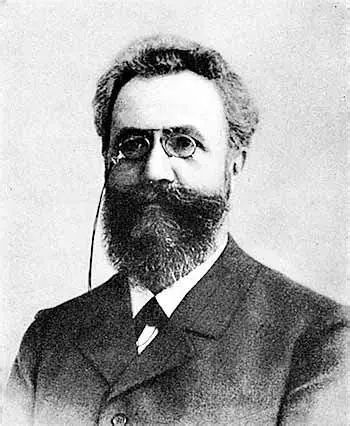
This concept was first scientifically explained by Hermann Ebbinghaus— a German psychologist, who, through experiments on memory and forgetting, showed the world that forgetting is a natural process.
Your brain isn’t working like a faulty machine. Actually, your brain is very smart. Think about it—
your brain is just like mobile phone storage 📱
Things that:
• are used repeatedly → remain saved
• are not used → get auto-deleted
The brain does the same thing. Information that is not revised is gradually deleted, considered as “unnecessary data,” in order to save energy.
This doesn’t mean you are weak. It simply means you are not giving your brain the signal that “this information is important.”
And this is where the game of smart revision begins…
C. The Ebbinghaus Forgetting Curve: Understanding the Pattern of Forgetting
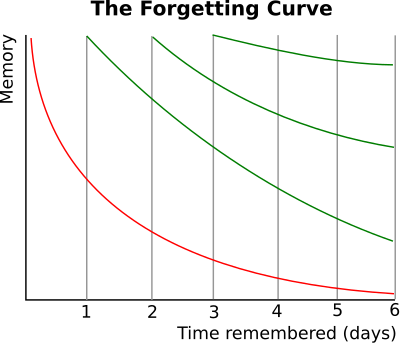
Now here comes the most eye-opening concept—the Ebbinghaus Forgetting Curve. Ebbinghaus observed that we don’t forget randomly, but rather there is a fixed pattern of forgetting.
Immediately after studying:
• In the first 20-30 minutes, the impact of much of the information begins to diminish.
• Within 24 hours, without revision, approximately 50-70% of the information is lost.
• After 1 week, only the things that have been revised remain.
This means that—
if you studied a topic on Monday and didn’t touch it again until Thursday,
then the feeling you get before the exam— “Sir, it feels like I’ve studied this… but I can’t remember it”
👉 This feeling isn’t due to laziness; it’s a natural effect of the Forgetting Curve. The good news is that this curve is not destiny. It’s possible to break it—
Most students repeat the same mistake again and again—revising by simply rereading their notes.
Opened the notebook ✔️
Picked up the highlighter ✔️
Marked the lines ✔️
And thought—”yes, revision done”
But the truth is that rereading only gives you familiarity, not memory.
That’s why when the book is in front of you, everything makes sense…
and when the exam paper is in front of you, your mind says—
“This looks familiar, but why can’t I remember it?” 😐
The brain likes comfort, but learning happens through discomfort. Rereading is easy for the brain, so the brain doesn’t put in much effort. And where there is no effort, there is no strong memory either.
👉 That’s why smart students don’t just read; they force their brains to recall.
And this is where the concept of Smart Revision is born—which we will understand in detail in the next section. 🚀
D. Smart Revision: Don’t Change Your Study Habits, Change Your Strategy
By now, one thing must be clear—the problem isn’t the quantity of studying, the problem is the method of studying.
Revision means:
• Reading everything repeatedly ❌
• Sitting for hours at the last moment ❌
Smart revision means:
• Revising at the right time ✅
• Retrieving answers from your brain (recall) ✅
• Strengthening memory pathways ✅

In simple words,
Smart revision = Giving your brain the signal that “this is important”
You can understand this process with a simple formula:
Memory = Revision × Timing × Technique
If you are revising but the timing is wrong, or the technique is weak, then the memory will not become long-term. That’s why:
• Some students remember things even with less studying
• And some students forget things even with more studying
The difference is only one thing— the strategy.
And now the next logical question is:
👉 “So when should I revise?”
The answer is the Golden Revision Timetable, which is based on the Ebbinghaus Curve. Let’s understand it in detail in the next section ⏳📘
E. The Golden Revision Timetable (Based on Ebbinghaus Curve)
If you want to signal to your brain that “this topic is important, don’t delete it,” then the timing of revision is most important. Ebbinghaus clearly showed that each revision slightly flattens the forgetting curve. This means—the better the timing of the revision, the stronger the memory.
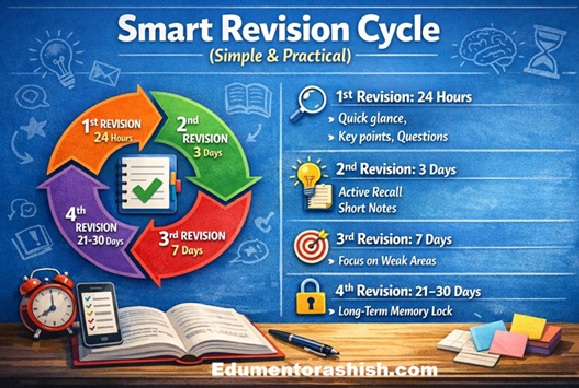
✅ Smart Revision Cycle (Simple & Practical)
• 1st Revision: Within 24 hours → quick glance, key points, questions
• 2nd Revision: After 3 days → active recall, short notes
• 3rd Revision: After 7 days → focus on weak areas
• 4th Revision: After 21–30 days → long-term memory lock 🔒

The magic of this process is that each revision takes less time, but the power of retention increases.
This timetable works for every subject— any subject, or any competitive exam.
Now the question is—
“I understand the importance of revision, but how to revise so that it’s not boring?”
The answer is memory techniques, which we will explore in the next section 🎯🧠
F. Memory Techniques that Actually Work (No Chance of Getting Bored)
If you only follow the timetable but the technique is wrong, then revision will still feel boring and ineffective. That’s why smart students use some brain-friendly techniques—
which make studying interesting and also strengthen memory.
🧠 1. Active Recall – Brain Gym
Close your notes. Ask yourself questions:
• “What were the main points of this topic? Just like you think about the main characters of a movie.”
• “What kind of questions could come in the exam? If I were preparing the exam paper myself, what questions would I give?”
If you don’t know the answer, understand that learning is happening. When the brain struggles, that’s when memory is formed.
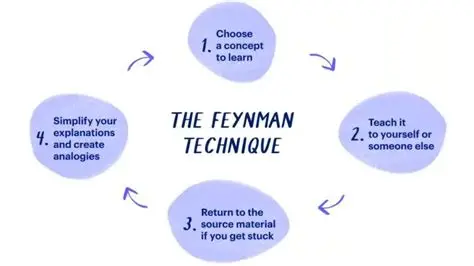
🗣️ 2. Feynman Technique – Become Your Own Teacher
Imagine you’re in a classroom teaching a junior student who’s asking you questions about their doubts. Explain it in simple language. Wherever you get stuck, that’s your weak area.
🖼️ 3. Visual Anchoring – See, Remember
The brain prefers images over text. Our mind connects one point to another, and this is both its weakness (if you’re getting distracted) and its strength (if you’re using it effectively). You should use “Spider Notes” including
• flowcharts
• diagrams
• mind maps
• A summary of the complete chapter in 2 pages after the complete notes for each chapter (This will help in quick revision).
A good diagram is more powerful than 5 pages of text.
📖 4. Story Method – Bring Dry Topics to Life
Create a story related to the topics. For example, suppose you have to remember the adverse effects of a drug, imagine a friend and see all the adverse effects in him in the form of a story.
Character + action + sequence = long-term memory.
🔄 5. Interleaving – Mix It Up a Little
Studying the same subject for hours ❌ Mixing it up a little ✅
This keeps the brain alert and reduces confusion.
👉 The goal of these techniques is the same—
to make revision a source of power, not a punishment.
G. How Do Top Students Revise? (The Secret Sauce)
Students often think, “Toppers are on a different level” or “They must have naturally strong memories.” But the reality is a little different.
The difference between top students and average students isn’t intelligence,
it’s their revision approach.

🔹 What Average Students Do
• They start revising only when the exam is near
• They rely on re-reading and highlighting
• They avoid weak topics
• They don’t have a fixed revision system
🔹 What Top Students Do Differently
• They start revising early
• They use fewer notes and more questions
• They tackle weak areas first
• They track their revision and follow the Eisenhower Matrix
Winners know that
“Confidence doesn’t come before the exam, it comes from following the revision cycle.”
That’s why when the exam approaches, they don’t panic—they just do the final polishing.
H. Common Mistakes in Revision (Avoid These!)
No matter how smart your strategy is, if you keep repeating some common mistakes,
the result will be the same old stress, confusion, and regret. See if you are also making these mistakes:
❌ 1. Revising Only Before the Exam
Delaying revision by thinking “There’s still time” is the biggest mistake.
If revision starts late, retention will remain weak.
❌ 2. Avoiding Weak Topics
Revising strong topics is comfortable, but growth always comes from addressing weak areas.
❌ 3. Passive Revision
Just reading, reading, and reading—without asking yourself questions. This doesn’t activate the brain.
❌ 4. No Tracking System
You write “I will revise tomorrow,” but when, what, and how much—is not clear.
❌ 5. Using the Same Technique Everywhere
Every subject and every topic is not the same. The technique needs to be adapted according to the topic.
Students often think—
“I understand the plan, but how do I start?”
That’s why here’s a simple 7-day starter plan that won’t overwhelm you and will help you build the habit of smart revision.
👉 Daily time: just 30–60 minutes
👉 Rule: consistency > intensity
📅 Day 1 – Topic Selection + First Recall
• Recall what you studied today
at night with your notes closed.
• Write down only the headings, formulas, and key points.
📅 Day 2 – 1st Smart Revision (24-Hour Rule)
• Quickrevision of yesterday’s topic
• Create questions: “What could come in the exam?”
📅 Day 3 – New Topic + Old Topic Mix
• Study a new topic
• Recall the old topic for 2–3 minutes
📅 Day 4 – Weak Area Focus
• Stop where you’re getting stuck
• Use diagrams, flowcharts, or the story method
📅 Day 5 – Teach Mode ON
• Teach yourself or an imaginary student
• Simple language = strong clarity
📅 Day 6 – 2nd Revision (3-Day Gap)
• Look at your short notes
• Try writing or speaking without looking at them
📅 Day 7 – Review + Plan Next Week
• What did you remember? What are your weak areas?
• Decide on your revision slots for next week
The goal of this 7-day plan is not to become a topper, the goal is to build a system.
Because once a system is in place, confidence and clarity automatically follow.
👉 Now, the last and most important point— revision is not just a game of technique,
it’s also a game of mindset.
If you think, “I forget things, my memory is weak,”
then no matter how many techniques you learn, the result will be limited. Therefore, keep giving yourself positive and constructive affirmations, such as:
• My memory is very good
• I remember things instantly
• Once I read something, I don’t forget it easily
When you make smart revision a habit, exam pressure decreases,
self-doubt gradually disappears, and learning becomes enjoyable.
J. Conclusion
If you want to remember only one thing from this entire blog, it is this—
You don’t remember less because you are weak, but because you revise in the wrong way.
Let’s quickly recap:
✔ Forgetting is natural, not a failure
✔ Re-reading is not revision
✔ Right timing + right technique = strong memory
✔ Smart revision reduces stress
✔ Consistency makes you confident before the exam
If you understand the Ebbinghaus Forgetting Curve and plan your revision accordingly, studying becomes not a burden,
but a systematic process.
👉 Make a decision today:
• Stop just studying
• Start revising smartly
If you found this blog useful, share it with your friends—maybe someone’s exam stress will be reduced because of you.
📌 For more such science-based study techniques, student motivation, and smart learning strategies,
keep visiting edumentorashish.com regularly. You can contact me directly at edumentorashish@gmail.com.
You can also visit my channels: Edumentor Ashish
Remember—
Smart students revise less, but revise right.



Just wish to say your article is as surprising The clearness in your post is just cool and i could assume youre an expert on this subject Fine with your permission allow me to grab your RSS feed to keep updated with forthcoming post Thanks a million and please keep up the enjoyable work