
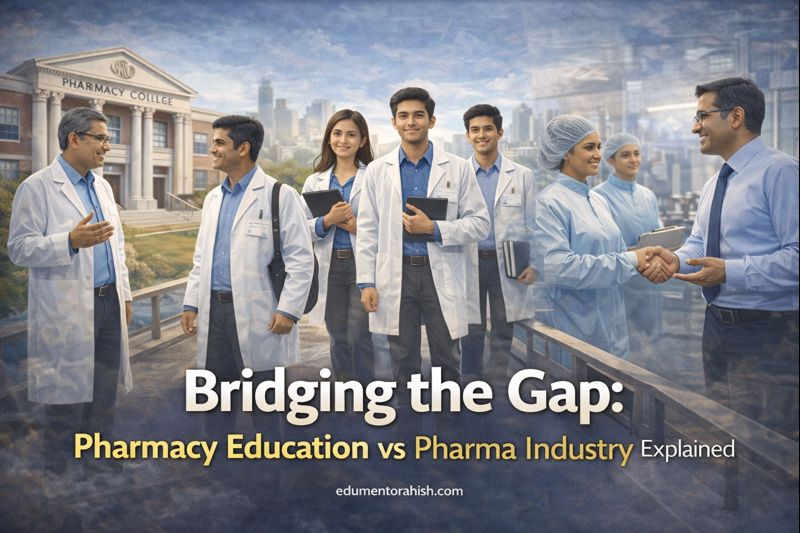
A. Introduction: The Reality Check
In today’s time, pharmacy colleges are producing degree holders, while the pharma industry needs skilled professionals.
Both are right in their own way.
A degree is necessary, and so are skills. But the problem is that the connection between the degree and the skills is missing, meaning there is a gap between what is being taught to the students and what the industry requires.
That’s why today we see that:
• Students have degrees, but lack confidence.
• The industry has opportunities, but can’t find job-ready candidates.
The problem is not talent.
The problem is alignment.
Because of this gap:
• Students get confused after completing their B.Pharm/M.Pharm. “Where will I find a job now? What does the industry expect?”
• Teachers feel helpless despite their best efforts because the syllabus and industry expectations don’t match.
• And the pharma industry has to train fresh recruits from scratch.

This blog is not meant to blame anyone. This blog is an honest attempt to build a bridge between the college, the student, and the industry.
B. College vs Pharma Industry: The Real Difference
To understand the gap, it’s important to first understand that colleges and the industry have different roles.
Neither is wrong — they simply have different focuses.
🎓 What Pharmacy Colleges Focus On
The main focus of colleges is:
• Completing the syllabus
• Exams and internal assessments
• Explaining theoretical concepts
• Following a fixed curriculum
• Ensuring good marks and results
Colleges teach students:
• The basics of the subjects
• Understanding of concepts
• Academic discipline
All of this is important because it’s difficult to progress without a strong foundation.
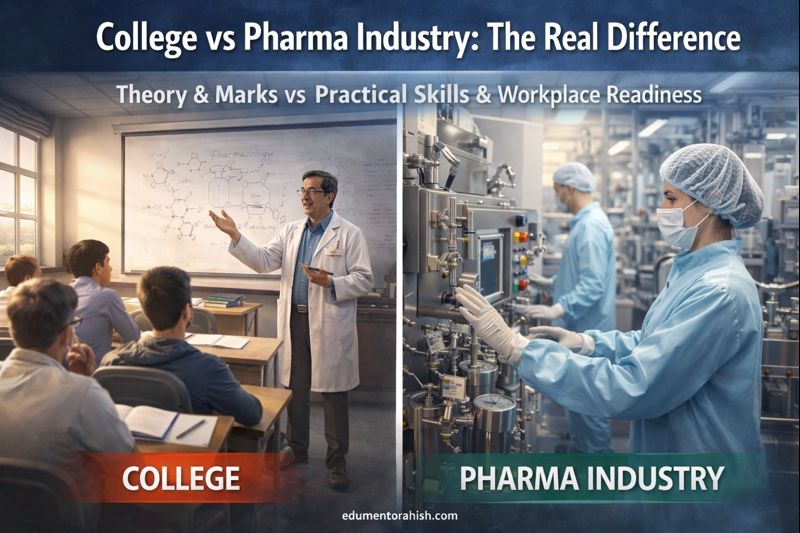
🏭 What the Pharma Industry Expects
The industry focuses on:
• Practical skills
• Real-life problem-solving
• SOPs and documentation
• GMP/GLP/compliance mindset
• Teamwork and communication
The industry asks:
• “Can you do the job?”
• “Do you understand the process or just the theory?”
• “Can you handle pressure?”
The industry needs ready-to-work professionals, not just students who have cleared exams.
⚠️ This is where the gap begins
The college says: “Understand the concept, and you’ll clear the exam.”
The industry says: “You should know how to apply the concept as well.”
The result of this gap:
• The student thinks: “We’ve studied everything, so why aren’t we getting jobs?”
• The teacher thinks: “We can’t go beyond the syllabus.”
• The industry thinks: “The people who come to us after completing their degrees lack practical knowledge and clarity, and we have to train them.”
👉 Theory without application is incomplete.
👉 Skills without a base are unstable.
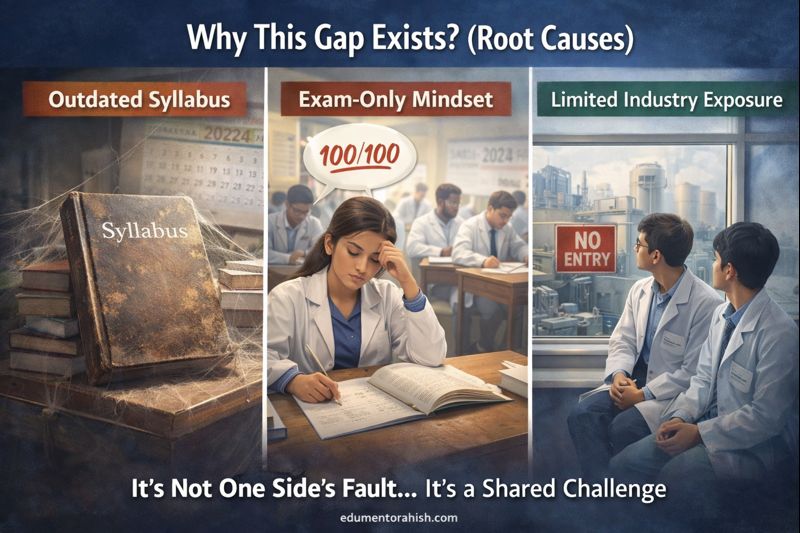
C. Why This Gap Exists? (Root Causes)
This gap didn’t appear overnight. There are multiple reasons behind it — at the college, student, and industry levels. First, it’s important to understand that this isn’t anyone’s fault.
🏫 College Level Reasons
• Outdated syllabus
The industry is changing rapidly, but the syllabus doesn’t get updated at the same pace.
• Limited industry exposure
Not every teacher gets direct industry experience, especially with new technologies.
• Time pressure
Lectures, exams, PCI/NAAC documentation, administrative work — teachers have little time for extra industry-oriented training.
• Infrastructure limitations
Not every college has advanced instruments or industry-like labs available.
• Exam-oriented mindset
The focus is mostly on: “I have to pass, I have to get good marks”
“We’ll worry about skills later”
Students don’t know: QA, QC, Production, Regulatory, Research — what does each role require?
• Fear of extra effort
Internships, training, certifications — everyone thinks these are “optional,” when in reality they are essential.
• Comfort zone
Studying only what’s in the syllabus feels safe. Students think that’s enough.
🏭 Industry Level Reasons
• Fast-paced environment
The industry has little time to train freshers from scratch.
• High compliance pressure
They can’t afford errors — GMP, audits, and documentation are strict.
• Expectation gap
The industry assumes that basic practical exposure is already present, which is not the reality.
💡 Good News
This gap is not permanent.
It can be bridged — if every stakeholder understands their role and contributes.
D. What Pharma Industry Actually Wants from Fresh Pharmacy Graduates
Many students think:
“The industry only wants a degree.”
The truth is: The industry uses the degree to shortlist candidates for interviews, but hires based on job skills. The industry doesn’t expect perfection from freshers, but it definitely expects basic readiness.
🔬 Technical Skills (Even at a Basic Level)
The industry doesn’t ask: “Are you an expert or not?”
The industry asks: “Do you know the basics?”
Fresh graduates are expected to have:
• A basic understanding of QA/QC/Production
• Knowledge of instrument names and their basic working (UV, HPLC, Dissolution, etc.)
• Understanding of the meaning and importance of SOPs
• Basic awareness of GMP/GLP
• Discipline in documentation
👉 The industry wants to see: “Is this person capable of learning?”
🧠 Soft Skills (Which are not mentioned in the syllabus)
This is where most students fail. The industry needs:
• Clear communication
• Time management & punctuality
• Ability to work in a team
• Habit of following instructions
• Professional behavior
A hard truth: Knowledge can get you through the interview, but attitude keeps you in the job.
📋 Documentation & Discipline Mindset
The industry’s work isn’t just about operating machines. The industry’s work involves:
• Maintaining records
• Following data
• Maintaining compliance
Therefore, the industry needs:
• A writing habit
• Observation skills
• Attention to small details
• The habit of understanding the “why”
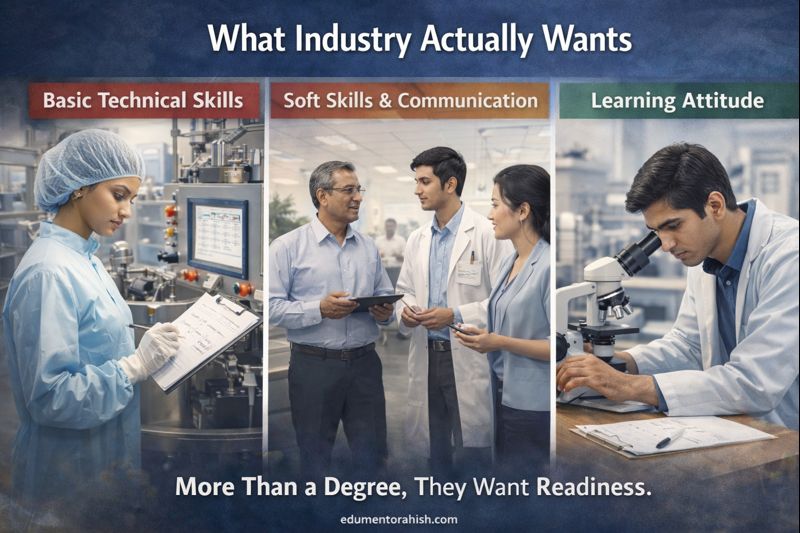
⚠️ Most Important Thing Industry Looks For
The industry first looks for:
• Do you want to learn?
• Do you accept feedback?
• Can you maintain discipline under pressure?
Skills can be taught. Changing attitude is difficult.
E. What Pharmacy Students Can Do (Take Responsibility)
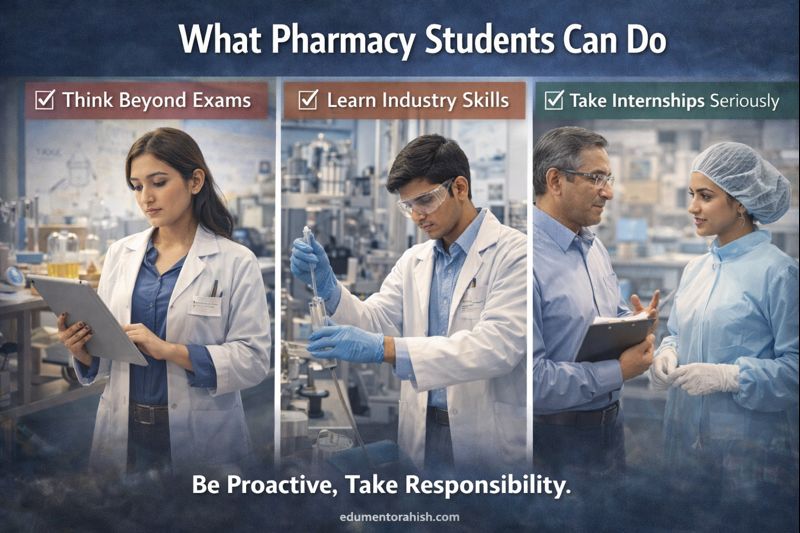
The truth is, relying solely on college is not enough to become industry-ready. This responsibility falls on the student themselves.
🎓 1. Think Beyond Exams
Exams are important, but exams don’t guarantee a career.
• Good marks ≠ job-ready
• Degree ≠ skill
If you’re only studying for exams, you’re just passing — not progressing. The industry looks at capability, not just results.
🔧 2. Learn Industry-Relevant Skills Early
Don’t think: “We’ll learn after getting a job.”
Start early:
• Basic understanding of instruments
• Habit of reading SOPs
• Practice documentation
• Excel/data handling basics
Learning a little bit every day automatically builds confidence.
🏭 3. Take Internships & Training Seriously
Internships aren’t for certificates. Internships are for experience.
• Observe
• Ask questions
• Take notes
• Try to understand the process
Those who take internships lightly, the industry takes them lightly too.
🧠 4. Develop the Right Mindset
The industry doesn’t just look at skills, it also looks at mindset.
Develop:
• Discipline over motivation
• Curiosity over fear
• Learning over comfort
Don’t be afraid of mistakes. Don’t take feedback personally.
🧭 5. Gain Career Clarity
Ask yourself:
• QA, QC, Production, Regulatory — what suits me?
• Which skills should I work on?
Clear goal = focused preparation.
F. What Pharmacy Teachers Can Do (Practically & Realistically)
This needs to be absolutely clear: Teachers are not the reason for the gap. But teachers can be the strongest medium to bridge the gap.
To create industry-ready students, teachers don’t need to change the entire system — they just need to change their approach slightly.
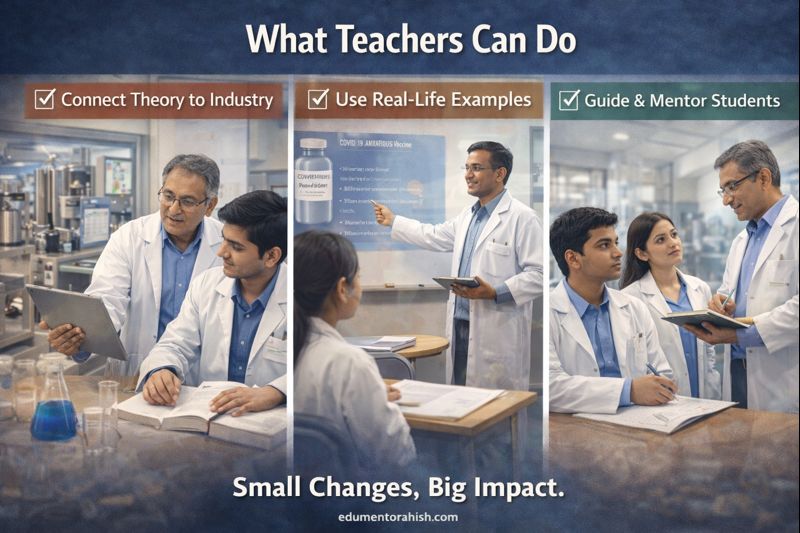
👩🏫 1. Explain the “Why” along with the “What”
It’s not enough to just say:
• “This topic is in the syllabus”
Explain to the students:
• Where this topic is used in the industry
• What its real-life relevance is
When the student understands the “why,” learning becomes automatic.
🧪 2. Use Industry Examples
Every topic can be connected to the industry:
• SOP examples
• Batch failure stories
• Audit observations
• Deviation & CAPA concepts
These things:
• Increase student interest
• Make theory practical
One real example is more powerful than 10 definitions.
📂 3. Give Skill-Oriented Assignments
Along with traditional assignments:
• SOP reading tasks
• Documentation format
• Case-study based questions
• Mini industry projects
If students get skills along with marks, they will take both seriously.
🔗 4. Maintain Industry Connect
Every teacher cannot be an industry expert — and that’s not necessary either.
Simple steps:
• Guest lectures (online/offline)
• Alumni interaction
• Industry visits (when possible)
• Short-term certifications
It’s not necessary for the teacher to know everything, but it is necessary to know what is important.
🧠 5. Develop a Mentor Mindset
A teacher is not just someone who completes the syllabus, a teacher is someone who provides direction.
• Career guidance
• Honest feedback
• Strength & weakness identification
These things are outside the syllabus, but they are inside the career.
✅ Reality Check for Teachers
Industry-oriented teaching does not mean:
• Extra pressure
• Extra workload
It means:
Making what you are teaching a little more meaningful.
G. Role of Institutions: Creating the Real Bridge
Both students and teachers try their best, but until the institution provides support, the industry-college gap cannot be fully bridged.
The good news is that institutions don’t need to bring about a revolution; they just need to take steps in the right direction.
🏫 1. Enhance Industry-Academia Collaboration
Institutions can build connections with the industry through:
• Guest lectures by industry professionals
• MoUs with pharma companies
• Short-term industrial training programs
• Involving alumni as industry mentors
This gives students:
• Real-world exposure
• Clearer expectations
• Natural motivation
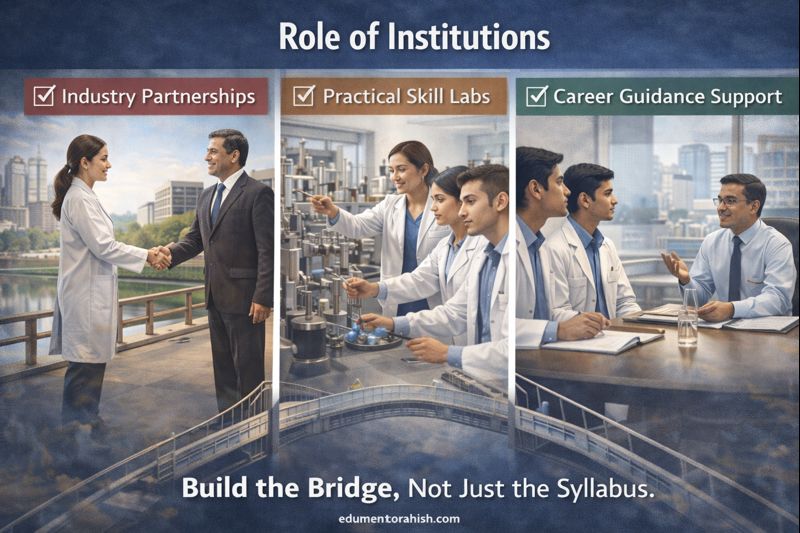
🔬 2. Focus on Skill Labs & Practical Exposure
Every college cannot build a world-class lab, but they can develop basic skill labs.
For example:
• Instrument demonstration labs
• Documentation practice area
• SOP reading & discussion sessions
Right exposure is more important than perfect infrastructure.
📚 3. Introduce Certification & Add-on Courses
Institutions can encourage:
• Industry-relevant certification courses
• Short modules on QA/QC/Regulatory basics
• Software tools (Excel, data handling, basics)
This increases employability value along with the degree.
🧭 4. Make the Career Guidance Cell Active
Career guidance shouldn’t be limited to just putting up posters. The role of an effective career cell:
• Awareness of industry roles
• Resume & interview guidance
• Alumni interaction
• Internship opportunities
• Observing students’ basic nature and suggesting career options accordingly (*Important)
Students gain clarity: “In which direction should I prepare?”
🤝 5. Seriously Monitor Internships & Training
Don’t let internships become just a formal requirement. Institutions should:
• Monitor internship quality
• Collect student feedback
• Define learning outcomes
Internships are only useful when they are learning-focused.
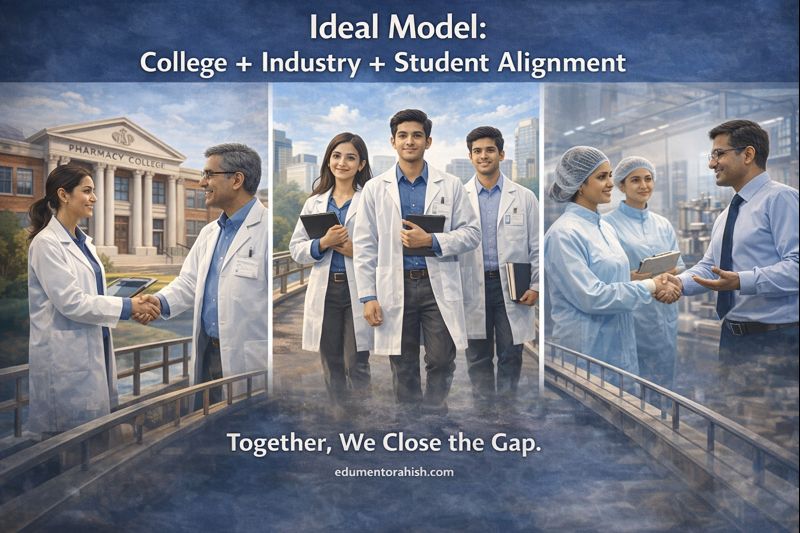
H. The Ideal Model: College + Industry + Student Alignment
The future of pharma education will be strong when the college, industry, and students work in the same direction. If all three move in different directions, the gap will remain. If all three align, the gap will automatically be bridged.
🔺 Student: The Center of the System
Role of the ideal student:
• Not just exam-focused, but skill-focused
• Self-awareness and introspection
• A hunger for learning
• Discipline and consistency
• Taking internships and training seriously
• Developing career clarity
A student doesn’t get a job; a student becomes worthy of a job.
🔺 Teacher: The Guide & Mentor
Ideal teacher:
• Explains industry relevance along with the syllabus
• Explains the “Why” along with the “What”
• Uses practical examples and case studies
• Observes students and their basic nature
• Provides direction and honest feedback to students
A teacher’s role is not just to teach, but also to show the path to a career.
🔺 Institution: The Enabler
Ideal institution:
• Encourages industry-academia collaboration
• Provides skill labs and add-on courses
• Monitors internships and training
• Supports both teachers and students
An institution’s job is not just to make rules, but to create an ecosystem of growth.
🔄 When All Three Align
• Students are confident
• Teachers are satisfied
• The industry gets job-ready professionals
And most importantly:
The respect for pharmacy education increases.
I. Future of Pharmacy Education: Where Are We Heading?
Pharmacy education is currently in a transition phase.
The industry is changing rapidly — and the education system needs to evolve at the same pace.
The good news is that the future of pharmacy is bright, but the approach shouldn’t be outdated.
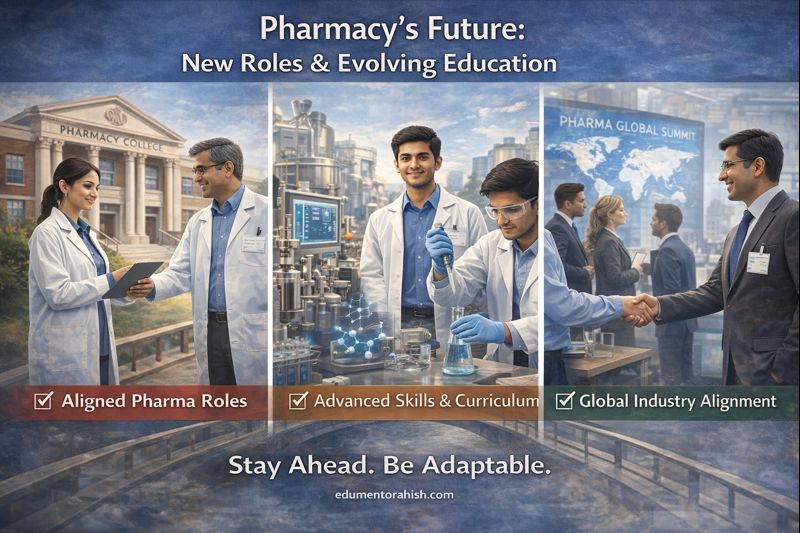
🚀 Emerging Areas in Pharma
Today and in the future, pharma will not be limited to:
• Tablets
• Capsules
• Manufacturing
Future roles will include:
• Regulatory affairs
• Pharmacovigilance
• Clinical research
• Data & documentation-driven roles
• Automation & AI-supported processes
This means:
Simply memorizing won’t be enough; a combination of understanding and skills is required.
🧠 Lifelong Learning Is the New Normal
Completing a degree is not the end, it’s the starting point. Future pharma professionals will need to:
• Regularly upskill
• Learn new guidelines
• Adapt to technology
Those who stop learning stop growing.
🎓 Teaching Methods Will Also Change In the future:
• Application-based teaching will increase
• Case studies and simulations will become common
• Industry participation will be greater
• The weightage of skill assessment will increase
The teacher’s role will become even more important — from knowledge provider to learning facilitator.
J. Conclusion: The Bridge Starts With Us
The gap between the pharma industry and pharmacy colleges didn’t appear overnight —
nor will it disappear with just a policy change.
To bridge this gap, we need to stop the blame game.
• Blaming only the colleges is not the solution.
• Blaming only the industry is not the solution.
• Blaming only the students is not the solution.
The solution will come when every stakeholder understands their responsibility.
🎓 Message for Students
Build skills along with your degree.
Don’t let college be a limitation —
make it your foundation.
The job market looks for capability, not just a degree.
👩🏫 Message for Teachers
You are not just completing the syllabus; you are shaping careers. A little industry connection, a little practical approach — and your impact will increase manifold.
🏫 Message for Institutions
College is not just about classrooms and exams; it’s a career launchpad. Industry collaboration and a focus on skills are not optional today, they are essential.
🌉 Final Thought
Bridging the gap doesn’t start with policy. It starts with mindset. When:
• The student takes responsibility
• The teacher creates relevance
• The institution provides support
then pharmacy education creates not just a degree, but a career.
📣 Call to Action
Ask yourself a simple question today:
“What can I do today to reduce this gap?”
Because to build a bridge, it’s not enough for only one side to be strong — both sides need to meet.
You can write to me at edumentorashish@gmail.com
You can also visit our YouTube Channels: