

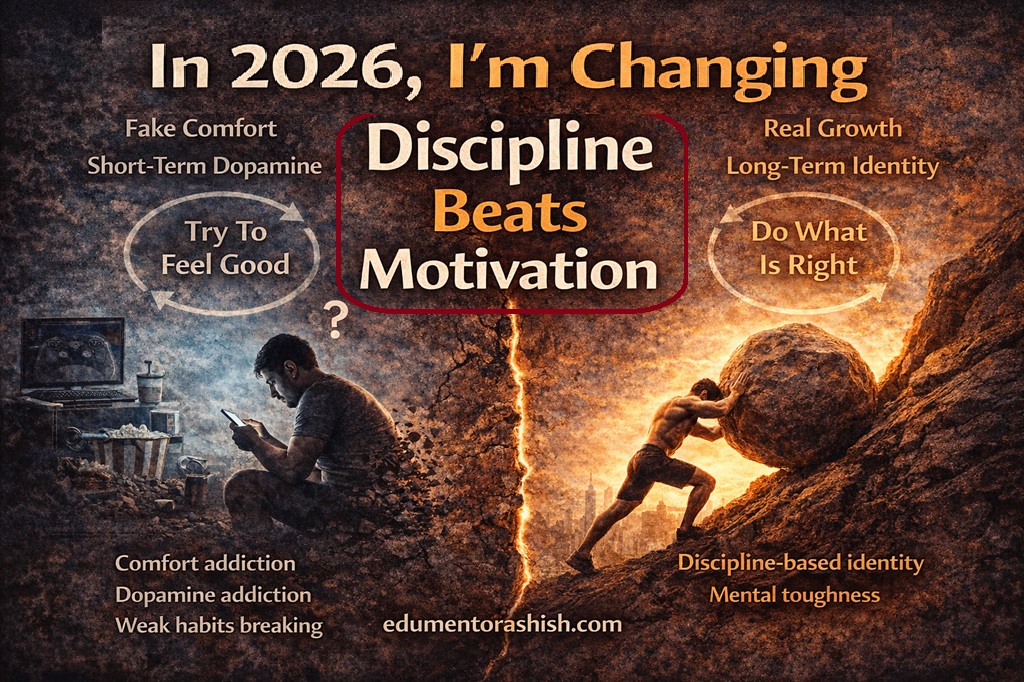
A. Introduction
I read a line by David Goggins — and to be honest, that line hit me like a slap in the face:
“Motivation is garbage.”
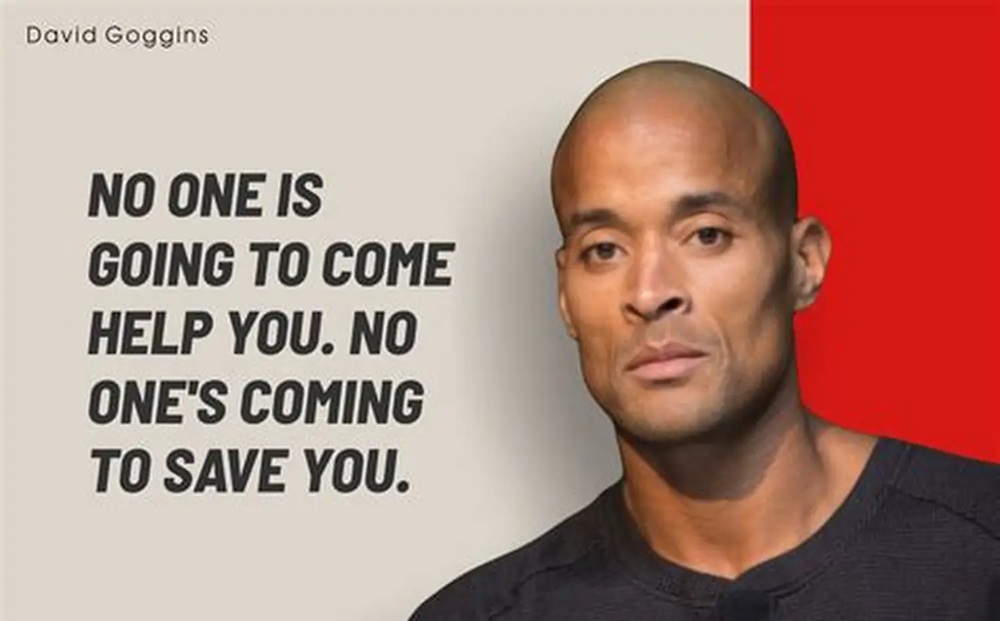
At first, I wondered — why so harsh? Then, slowly, I understood… he wasn’t wrong.
- Motivation feels good.
- Motivation gives you energy.
- Motivation comes with reels and quotes.
But the problem is that motivation is temporary.
Mood changes, motivation is gone.
Fatigue sets in, motivation is gone.
You pick up your phone, motivation is gone.
- Discipline is the complete opposite.
- Discipline isn’t comfortable.
- Discipline is painful but discipline delivers permanent results.
In today’s dopamine-driven era, motivation dies even faster — because we’ve become so addicted to instant pleasure that even a little effort feels like a burden.

And that’s where the real problem begins.
The biggest enemy today isn’t laziness. The biggest enemy today is — comfort addiction. We don’t run away from work… we run away from discomfort.
B. Why Motivation Fails in Today’s Dopamine Era
🔹 What is Dopamine?
Dopamine is not a “happiness chemical,” it’s a chemical of anticipation. Dopamine is released when we anticipate pleasure.
In today’s world, getting a dopamine hit has become very easy:
• Mobile notifications
• Instagram/YouTube reels
• Likes, comments, validation
• Sugar, junk food
• Netflix, web series, binge-watching
All of these provide instant dopamine hits—without any effort. This is where the problem begins. When the brain repeatedly receives rewards without effort, it gradually learns to avoid effort. Then studying, working, research, teaching—everything starts to feel burdensome.
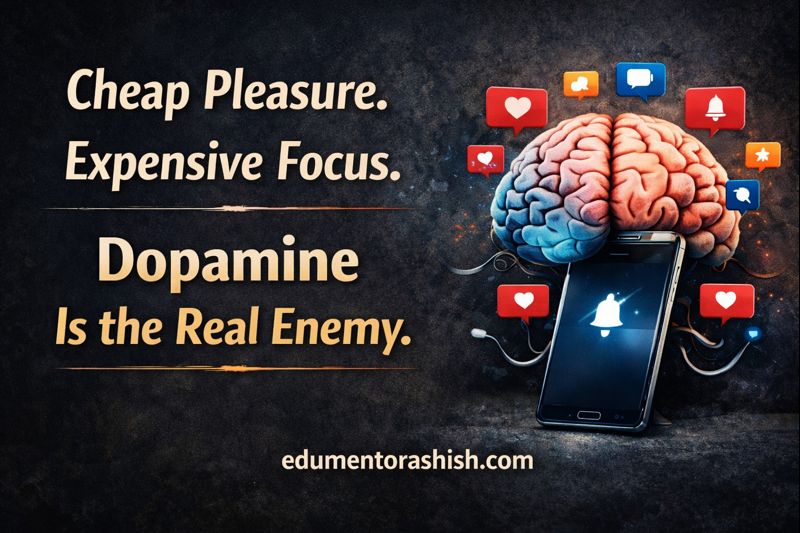
When pleasure is cheap, effort becomes expensive.
This is why:
• Students want to study, but can’t focus
• Professionals know what to do, but keep procrastinating
• Teachers, despite their passion, start feeling burned out
Motivation fails here—because dopamine teaches the brain short-term comfort, and makes discipline feel like pain. And when comfort becomes a habit, motivation remains only a temporary excitement.
C. Discipline > Motivation
The truth is, comparing motivation and discipline is unfair.
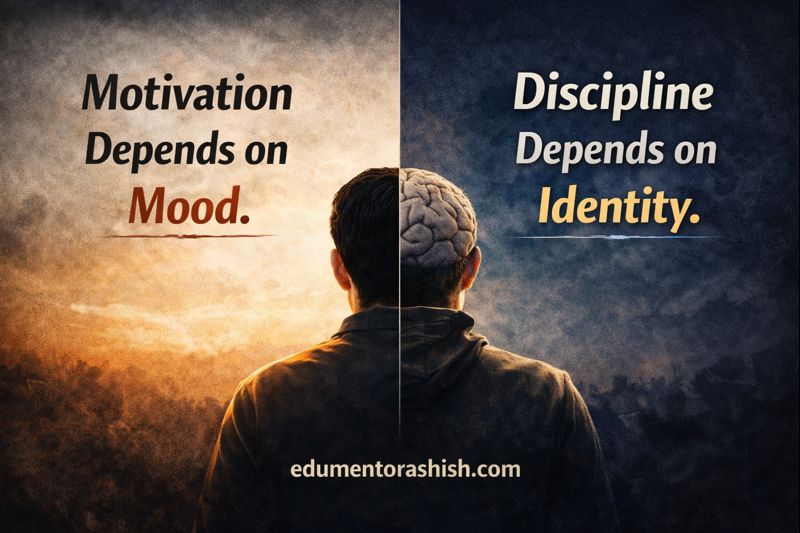
Motivation depends on mood.
Good mood → work gets done.
Bad mood → work stops.
That’s why motivation is unstable.
Discipline is a completely different thing.
Discipline depends on identity.
Motivation asks:
👉 “How am I feeling today?”
Discipline asks:
👉 “Who am I?”
A disciplined person doesn’t think:
• Whether I feel like it or not
• Whether I’m in the mood or not
• Whether I have the energy or not
They only believe one thing:
“I am someone who gets the job done, no matter how I feel. I do what needs to be done, whether I like doing it or not.” This is where a powerful concept comes in —
identity-based habits, which are explained very clearly in Atomic Habits.
When you define your identity, discipline becomes automatic.
For example:
• “I am a disciplined student”
• “I am a teacher who studies every day”
• “I don’t make excuses”
Then the question is no longer
“Do I have motivation today or not?” The only question is:
“This is what I do, because this is who I am.”
Motivation can change feelings. Discipline changes the person.
D. Dopamine Detox: Myth vs Reality
Nowadays, “dopamine detox” has become a fashionable term. People either overreact to it,
or completely ignore it. So, let’s clarify things first 👇
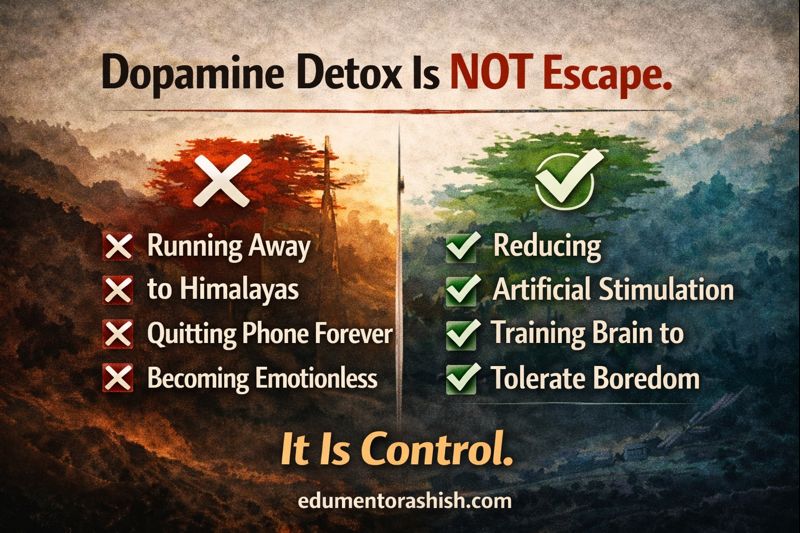
❌ What Dopamine Detox IS NOT
Dopamine detox absolutely does not mean:
• Running away to the Himalayas and leaving everything behind
• Turning off your mobile phone for life
• Becoming a robot instead of a human
• Eliminating your emotions
If that were the case, only monks would be successful. The reality is much simpler.
✅ What Dopamine Detox ACTUALLY IS
Dopamine detox means taking back control, not running away.
1️⃣ Reducing artificial stimulation and this artificial stimulation is
– picking up your phone without reason
– reels, shorts, instant gratification
– unnecessary sugar & junk content
2️⃣ Teaching your brain to tolerate boredom
Today we are afraid of boredom. But focus and creativity emerge from boredom. It is often said, “Be bored to be great and successful.”
3️⃣ Making pain familiar instead of unfamiliar
– a little discomfort
– a little effort
– a little struggle
All of this is training for the brain. The goal of dopamine detox is not to eliminate happiness, but to normalize effort.
When your brain learns to tolerate boredom and pain, discipline becomes automatic.
And then you don’t even need motivation.
E. Simple & Practical Dopamine Detox Steps
Dopamine detox isn’t about reading theory, it’s about following small daily practices.
These steps are simple — but powerful.

🔹 Step 1: Learn to Delay Dopamine (10-Minute Rule)
The mistake we make is that we want pleasure instantly.
The solution is — delay.
The rule is simple: Whatever gives you pleasure, do it 10 minutes later.
Example:
• Want to watch reels? → Read for 10 minutes first
• Want tea? → Work for 10 minutes first
• Want to listen to music? → After completing your task
Dopamine detox doesn’t mean giving up, it means gaining control. Discipline starts with delay, not denial.
🔹 Step 2: Create Low-Dopamine Mornings (Game Changer)
The first hour of your morning sets the tone for your entire day.
Rule:
❌ No phone
❌ No reels
❌ No WhatsApp
❌ No news
Just these 4 things:
• A little reading
• A little writing
• A little walking
• Planning your day
When the day starts without dopamine, the brain goes into focus mode.
🔹 Step 3: Boredom Training (The Most Important Step)
Today we are so afraid of boredom that we keep picking up our phones to avoid it.
Practice:
Sit for 10-15 minutes every day without any stimulation
• No phone
• No music
• No scrolling
Just alone… with your thoughts. Boredom is not a problem. Boredom is a gym for the mind.
Where boredom is tolerated, focus develops.
🔹 Step 4: Pain Scheduling (Shortcut to Mental Strength)
Every day, deliberately choose one uncomfortable task. Such as:
• Studying a difficult topic
• Washing your face with cold water
• Asking for feedback
• Accepting a mistake
• Having a difficult conversation
This sends a message to the brain: “Pain is not dangerous.” And when the pain becomes familiar, discipline starts to feel natural.
🔹 Step 5: One Screen Rule
Only one screen at a time.
• While studying → phone away
• While working → notifications off
• While eating → no screen
Multitasking disrupts dopamine and kills focus.
A dopamine detox is not a one-day event. It’s a daily lifestyle decision. Accept small discomforts daily, and bigger problems will automatically decrease.
F. The Three Fears That Destroy Discipline
Many people attribute a lack of discipline to laziness. But the reality is that discipline is often broken due to fear. Three silent fears are constantly running in the minds of people today — which prevent them from taking action.
🔴 Fear #1: Fear of Rejection
This fear says:
• “What will people think?”
• “What if they say no?”
• “What if I get rejected?”
Because of this fear, people:
• Don’t ask questions
• Miss opportunities
• Are afraid to express their opinions
Reality check: Rejection doesn’t define your value. Rejection is just feedback.
🔧 Practical Training:
Intentionally face small rejections every week:
• Ask a question you’re unsure about
• Ask for help
• Share an idea
A mind that runs away from rejection never becomes strong.
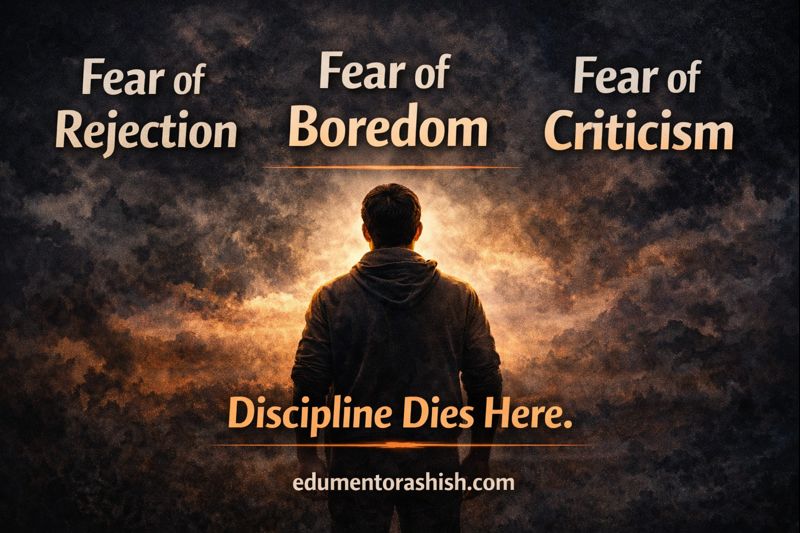
🔴 Fear #2: Fear of Boredom
This is the most dangerous fear — because it’s invisible.
Today, people are so afraid of boredom that even sitting idle for 5 seconds feels difficult.
The truth is:
Growth is boring.
Mastery is monotonous.
🔧 Practical Training:
• Study without music
• Walk without your phone
• Eat without a screen
When you learn to tolerate boredom, focus comes naturally.
🔴 Fear #3: Fear of Mistakes & Criticism
This fear says:
• “What if I make a mistake?”
• “People will judge me”
• “They will think I’m foolish”
Because of this, people:
• Don’t even start
• Keep waiting for perfection
• Delay their growth
Truth:
If you’re not being criticized, you’re not trying anything new.
🔧 Practical Training:
• Openly accept your mistakes
• Ask for feedback
• Focus on improvement, not on your image
The pain of criticism is temporary, but the pain of regret is permanent. The person who faces these three fears—rejection, boredom, and criticism—
for them, discipline becomes not a struggle, but an identity.
G. “Prepare for Pain” – Why This Advice Is Often Misunderstood
Whenever people say — “Prepare for pain” — people often think that they will have to make life unnecessarily difficult. That’s why many people reject this advice.
But there’s a huge misunderstanding here.
“Prepare for pain” absolutely does not mean:
• Always be in sorrow
• Remove all enjoyment from life
• Turn everything into torture
The reality is:
Trying to avoid pain is what causes the most pain.
Life gives two options — either choose the pain of discipline, or the pain of regret.
The pain of discipline:
• Is temporary
• Is a little uncomfortable today
• Makes the future strong

The pain of regret:
• Stings every day
• Is silent
• Stays with you for life
And most importantly: Pain is unavoidable. The only choice is which pain to choose.
Those who mentally prepare for pain are not surprised by failures. Criticism doesn’t break them. Boredom doesn’t scare them. Because they have already accepted: “Yes, there will be some pain… but I won’t stop.” This mindset is the foundation of real success.
H. Mental Toughness Isn’t Born — It’s Trained
Many people think:
• “They are mentally strong, I’m not”
• “They have more willpower”
• “I can’t do it”
These are all myths. The truth is:
Mental toughness isn’t in anyone’s genes; it’s built through daily training.
Just as the body becomes strong by going to the gym, the mind becomes strong through resistance.
Every time you:
• Start important tasks even when you don’t feel like it
• Continue working despite boredom
• Improve despite criticism
• Follow discipline despite fatigue
…you send a message to your brain: “I can stay in control even in difficult situations.”
And this message is the foundation of mental toughness.

Strong people don’t have easy lives. They have simply stopped running away from hard situations.
Therefore, the formula for mental toughness is simple:
• A little discomfort every day
• A little struggle every day
• A little resistance every day
Those who practice becoming a little stronger every day can never be completely broken by life.
Mental toughness is not a miracle — it’s the compound effect of discipline.
I. A Simple Daily Discipline Framework (3 Non-Negotiables Rule)
The biggest myth about discipline is that it requires high motivation.
The reality is: Discipline comes from clarity, not energy.That’s why you need a simple system — one that is independent of mood, motivation, and circumstances.
🔑 The 3 Non-Negotiables Rule
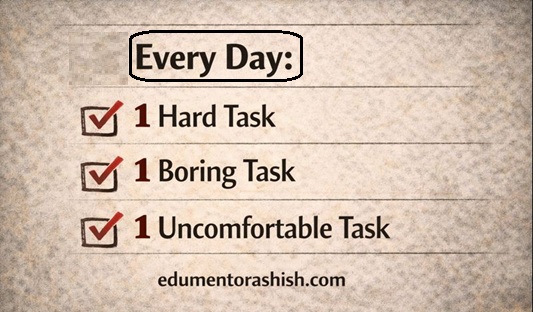
Only three tasks will be mandatory every day. Whether the day is good or bad — these three will get done.
1️⃣ One Hard Task
The task you’ve been avoiding:
• Difficult topic
• Pending work
• Important but uncomfortable task
The only rule: Do it first.
2️⃣ One Boring Task
The task that lacks excitement:
• Revision
• Practice
• Routine paperwork
• Task with slow progress
This task builds boredom tolerance.
3️⃣ One Uncomfortable Task
The task that challenges your ego:
• Asking for feedback
• Accepting mistakes
• Having an honest conversation
This task helps you grow mental strength.
The three tasks don’t need to be perfect. They just need to be completed.
Consistency > Intensity
The day you complete these three tasks, that day will be considered a win for discipline. Even if the rest of the day is average.
Why This Works
• It eliminates decision fatigue
• It provides clarity to the brain
• Discipline starts becoming a habit
You don’t wait for motivation, you follow the system. And the system always wins.
J. Final Thoughts: Don’t Rely on Motivation, Change Your Identity
The essence of this entire blog is simply this: Don’t rely on motivation. Rely on your identity.
- Motivation comes and goes. Dopamine gives false comfort.
- Comfort provides temporary relief — but steals your future.
- Discipline is never easy, but it’s always honest.

If you ask yourself every day: “Do I feel like doing it today or not?”
Then progress will always be slow. But the day you start asking yourself: “This is what the person I want to become does.”
That day, discipline stops being a struggle — it becomes your identity.
Remember:
• People who run away from pain aren’t weak — they’re just untrained.
• People who fear boredom aren’t lazy — they’re just dopamine-addicted.
• People who are afraid of criticism aren’t talentless — they’re just fear-driven.
And most importantly:
Real success comes to those who are prepared for pain, not those who are dependent on motivation.
🧠 Call to Action (CTA)
Make a decision today:
• Comment below and tell us: Which fear controls you the most?
• Share this blog with a student, teacher, or professional.
• And if you want more content on discipline, mindset, and real growth,
visit www.edumentorashish.com regularly.
• You can write to me at edumentorashish@gmail.com
You can also visit our YouTube channels:
Accept small discomforts today, so that life doesn’t teach you discomfort tomorrow.



https://www.youtube.com/watch?v=26mlZCwWh_Q&t=2s
i enjoy reading this great article, i have shared it many times on my website and started following you, Do you post more often ?? i am the owner of https://webdesignagenturbayreuth.de/ a webdesign agency in bayreuth Germany, webdesign agentur bayreuth, you can link up if you are interested. Thank you